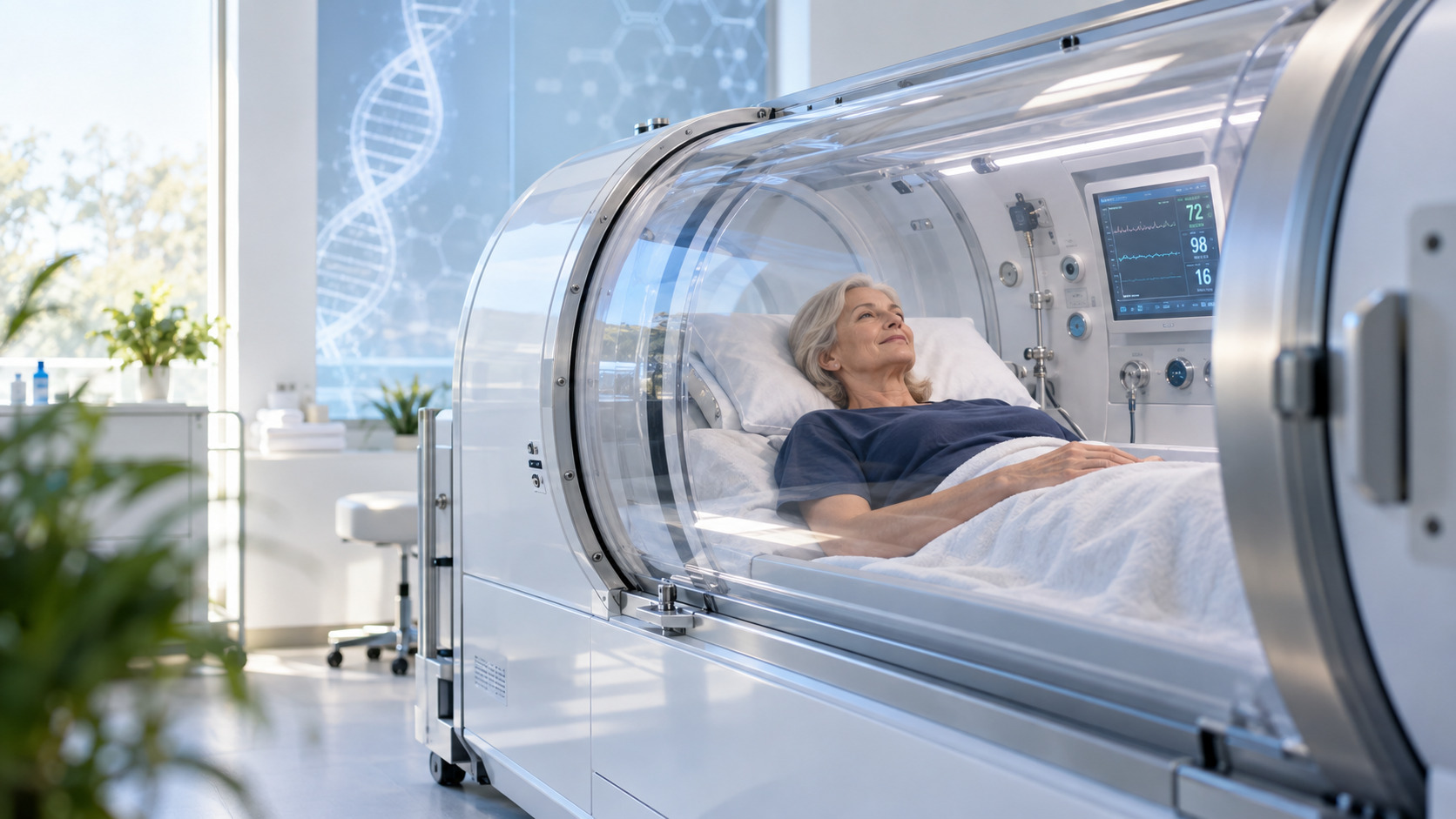
Hyperbaric oxygen therapy (HBOT) appears to impact certain markers linked to cellular aging. In a small, uncontrolled study, exposure to 60 sessions of HBOT reportedly produced longer telomeres and fewer senescent immune cells. However, the direct relationship between hyperbaric oxygen therapy and aging remains debatable, since researchers still lack conclusive evidence that HBOT slows overall body aging, prevents age-related diseases, or extends longevity.
The idea of stepping inside an oxygen chamber to slow down your cellular clock sounds too good to be true. But there is some early evidence behind the theory. Thanks to modern research on anti-aging and a fair amount of celebrity enthusiasm, HBOT has become a hot topic.
A small human trial found changes across two prominent cellular markers directly linked to aging. That alone has raised more than one pressing question. In this blog, we look at whether HBOT, traditionally used for wound healing and decompression sickness, could influence these aging-related cellular markers in healthy older adults, and what the research actually shows.
Telomeres and senescent cells are the two cellular markers of biological aging most relevant to HBOT research. Researchers use a variety of biomarkers to study aging at the cellular level, but these two have drawn particular attention because of how their mechanisms work. Understanding them is important for evaluating any therapy marketed for healthy aging.
Telomeres sit at the ends of chromosomes, protecting genetic material during cell division, much like the plastic tips on shoelaces prevent the laces from fraying. Telomeres shorten a little with each cell division. When they get too short, cells can no longer divide properly and either enter senescence or begin to malfunction. Telomere length is one of the most studied biological aging markers, and a main target of hyperbaric oxygen therapy and aging research.
Senescent cells stop dividing after a certain point but remain in tissue rather than being fully cleared from the body. They release inflammatory signals that damage the healthy cells around them, a process researchers connect to chronic, low grade inflammation and several conditions associated with aging.
Together, these two markers help researchers evaluate biological aging beyond the number of years a person has lived.
The trial that changed the current discussion around hyperbaric oxygen therapy and aging was led by Dr. Shai Efrati and Dr. Amir Hadanny at Shamir Medical Center, and published in the peer-reviewed journal Aging. You can read the full study on PMC.
In this trial, 35 healthy adults aged 64 and older were enrolled, and 30 completed 60 sessions over 90 days, five sessions a week, 90 minutes each, breathing 100 percent oxygen at 2.0 atmospheres of pressure. Blood samples taken before and after the protocol showed the following changes:
| Biological Marker | Change After Treatment | Health Implication |
|---|---|---|
| Telomere length, B cells | Increased by 38% on average | The most pronounced change measured in the study |
| Telomere length, T helper cells | Increased by 29% on average | Restores cellular replication capacity |
| Telomere length, T cytotoxic cells | Increased by 20% on average | Supports systemic immune function |
| Senescent T helper cells | Decreased 37% | Lowers markers of chronic inflammation |
| Senescent T cytotoxic cells | Decreased 11% | Modest gains in tissue repair environment |
Though these results do not prove that HBOT can reverse aging, they do suggest the therapy may influence major cellular processes related to biological age. The study itself carries real limitations worth noting: it had no control group, the sample size was small, and roughly a quarter of participants were excluded from the telomere or senescence analysis due to low sample quality. The researchers also have not yet established how long these changes last. Still, more clinical studies are needed before HBOT can be considered a proven anti-aging intervention, and these early findings mark it as a promising area of research with possible effects on healthy aging and skin quality.
At 2.0 atmospheres of pressure, oxygen dissolves directly into blood plasma, lymph, and cerebrospinal fluid, reaching tissue that normal breathing struggles to supply. This is why hyperbaric oxygen therapy and aging research focus less on oxygen concentration and more on how each session is structured, specifically the way oxygen pressure is delivered.
In this mechanism, extra oxygen pressure is applied at frequent intervals, creating repeated shifts between oxygen-rich and normal breathing conditions. This pattern is known as the hyperoxic-hypoxic paradox. Some documented downstream effects include:
Together, these responses may help explain why HBOT is being studied beyond its traditional medical uses. By triggering cellular repair mechanisms normally associated with low oxygen stress, the therapy may support tissue regeneration, recovery, and other biological processes linked to healthy aging. While researchers continue to investigate these effects, the hyperoxic-hypoxic paradox remains one of the central theories behind HBOT’s potential role in healthy aging.
Beyond the 2020 trial, researchers reported secondary improvements in memory, attention, and processing speed among participants. Outside the lab, athletes and physicians treating brain injuries have used similar protocols for years to support tissue repair and recovery.
Clinical interest in hyperbaric oxygen therapy and aging is also growing in dermatology, where improved circulation and collagen support may help with visible photoaging. A follow up trial from the same research group looked specifically at skin, and found measurable changes in collagen and elastic fiber structure after HBOT. You can read that skin aging study here. For a broader look at where the research stands, this 2024 review in Frontiers in Aging covers HBOT’s role in regenerative therapy and anti-aging more generally.
Yes, HBOT is reportedly safe, but only under clinical supervision. Clinics that market HBOT for wellness and skin aging do not always follow the same protocol evaluated in clinical aging research. The 2020 study used 100% oxygen at 2.0 ATA for 90 minutes across 60 sessions.
By comparison, many home or wellness pods typically operate at substantially lower pressures, often around 1.3 ATA, and have not been shown to produce the same biological effects seen in clinical trials.
The FDA continues to remind providers and facilities that medical grade HBOT devices require proper setup, trained supervision, and adherence to manufacturer safety protocols, and it has issued recent safety guidance for healthcare providers using HBOT devices. Treatment should be preceded by a thorough screening process, including checks for conditions such as untreated lung disease or certain ear problems.
Reported side effects tend to be mild and can include ear or sinus discomfort with pressure changes, temporary vision changes, and occasional fatigue. The results on aging are promising but not proven, and HBOT for this purpose remains investigational compared with its FDA recognized applications. Harvard Health has a clear breakdown of which HBOT uses are backed by solid evidence and which remain unproven.
The therapy is most effective when combined with an active lifestyle, including regular physical activity, good nutrition, and mental engagement.
Aging remains inevitable, but the 2020 study showed that some biological markers of aging may respond to HBOT. Further studies are needed to confirm and extend these results, but hyperbaric oxygen therapy and aging is already seen as a promising area of research, with possible effects on staying healthy as you get older.
Anyone thinking about using hyperbaric oxygen therapy for aging or skin concerns should talk to a doctor who specializes in this treatment. A complete check up can help determine whether the treatment is right, safe, and aligned with your health goals.

To get started, please share your name, phone number, and email, and we'll be ready to assist you!
Powerdby B3NET.com
