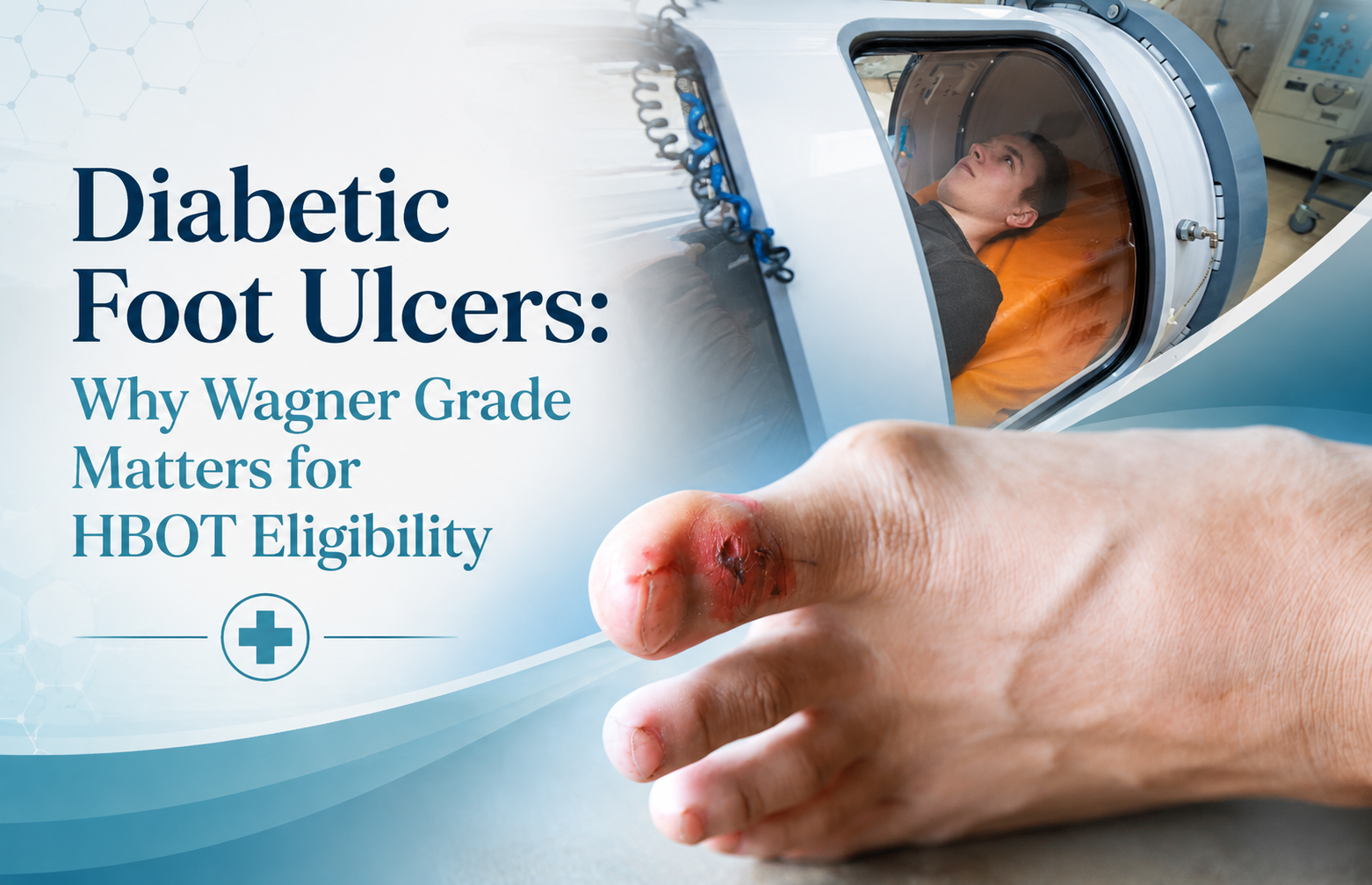
Diabetic foot ulcers are one of the most common and most serious complications of diabetes. Roughly one in four people with diabetes will develop a foot ulcer at some point in their life, and when these wounds don’t heal, the consequences can escalate quickly, from chronic infection to hospitalization to amputation.
Hyperbaric oxygen therapy (HBOT) is a recognized, FDA-cleared treatment for these wounds as part of our broader guide to HBOT for Wound Healing, but not every diabetic foot ulcer qualifies. Eligibility hinges on a specific clinical measurement: the Wagner Grade of the wound. Understanding what that grade means, and why it matters, is the first step for any patient or caregiver exploring HBOT as a treatment option.
Diabetes damages the body’s healing process in two compounding ways. High blood sugar impairs circulation, reducing blood flow to the extremities, while nerve damage (neuropathy) often means patients don’t feel the wound forming in the first place. By the time an ulcer is noticed, it may already be infected or have penetrated deep into surrounding tissue.
Poor circulation means these wounds are chronically starved of oxygen, the one resource healing tissue needs most to fight infection, build new blood vessels, and regenerate skin. Standard wound care, including debridement, offloading pressure from the wound, glucose management, and infection control, is the first line of treatment. When that alone isn’t enough, hyperbaric oxygen becomes a clinically supported next step.
Developed in the 1970s, the Wagner Classification System is the most widely used tool for grading diabetic foot ulcer severity, and it’s the standard that hyperbaric medicine and insurers rely on for treatment decisions. It scores wounds on a six-point scale, from 0 to 5, based on depth and the presence of infection:
Grades 0 through 2 are typically managed with standard wound care alone. Grade 3 is the turning point, both clinically and administratively.
Grade 3 marks the point where infection has reached bone or deep tissue, and the risk of amputation rises sharply. It’s also the specific threshold Medicare uses to determine HBOT coverage for diabetic wounds of the lower extremity, under CMS National Coverage Determination 20.29.
To qualify, a wound generally needs to meet three conditions:
If HBOT is initiated and a wound shows no measurable improvement within any 30-day period during treatment, coverage for continued sessions is generally not extended. This is why accurate, documented grading matters so much, both for identifying patients who will actually benefit and for securing insurance approval.
Inside a hyperbaric chamber, patients breathe 100% oxygen at increased atmospheric pressure. This dramatically raises the amount of oxygen dissolved directly in the blood plasma, allowing it to reach tissue that damaged or blocked blood vessels can no longer supply effectively.
For a Wagner Grade 3 or 4 wound, that extra oxygen does several things at once: it supports the formation of new blood vessels (angiogenesis), improves the ability of white blood cells to fight infection, and stimulates the collagen production needed to rebuild tissue. A 2018 retrospective study published in Advances in Wound Care, which analyzed outcomes across more than two million wounds, found that among patients with Wagner Grade 3 or 4 diabetic foot ulcers specifically, those who completed their full prescribed course of HBOT sessions achieved a 75.24% healing rate, compared to 60.01% for patients who received HBOT without completing the full course. That gap is a large part of why treatment adherence matters as much as initial eligibility.
A typical HBOT protocol for a diabetic foot ulcer involves daily sessions, five days a week, over a course that commonly runs 20 to 40 sessions depending on the wound’s response. Each session generally lasts 90 minutes to two hours. Progress is tracked continuously; wound measurements and imaging guide whether treatment continues, and whether the patient’s grade has changed enough to affect ongoing coverage.
What Wagner grade qualifies a diabetic foot ulcer for HBOT? Wagner Grade III or higher, meaning the wound involves an abscess, bone infection (osteomyelitis), or infection tracking through the tendon sheaths.
Does Medicare cover hyperbaric oxygen therapy for diabetic wounds?
Yes, when the wound is Wagner Grade III or higher and hasn’t responded to at least 30 days of standard wound care, under CMS National Coverage Determination 20.29.
How long does HBOT treatment take for a diabetic foot ulcer?
Most protocols run 20 to 40 daily sessions, each lasting 90 minutes to two hours, with progress reassessed regularly throughout the course.
What happens if a Wagner Grade 3 wound isn’t improving with HBOT?
If there are no measurable signs of healing within any 30-day period of treatment, Medicare coverage for continued sessions generally stops, and the care team will reassess the treatment plan.
If you or someone you care for has a diabetic wound that isn’t healing with standard care, a Wagner Grade assessment from a wound care specialist is the necessary first step toward finding out whether HBOT is an option. Find a certified HBOT clinic near you to start that conversation with a provider who can evaluate your wound and coordinate care.
This article is for informational purposes only and is not a substitute for professional medical advice. Always consult a licensed healthcare provider before starting Hyperbaric Oxygen Therapy.

To get started, please share your name, phone number, and email, and we'll be ready to assist you!
Powerdby B3NET.com
